Mechanical Keyboard Statistics 2026
By SwitchPicks . 9 min read . Updated June 2026
Mechanical keyboards have grown from a niche enthusiast hobby into a multi-billion-dollar market, pulled along by gaming and a deep custom-build community. This page collects more than 30 fully sourced statistics for 2026: how large the market is, how fast it is growing, how gaming and enthusiast use compare, which switches and keycaps dominate, and what a custom build actually costs. Every figure names its source and year. Estimates vary between research firms, so each number is tied to the firm and base year that published it.
Quick answer
SNS Insider values the global mechanical keyboard market at 1.97 billion dollars in 2024, projected to reach 5.26 billion by 2032 at a 13.12 percent CAGR. Gaming drives the category at 63.7 percent of the market, linear switches lead at about 43 percent, and North America holds roughly 34 percent of revenue.
This guide contains affiliate links. SwitchPicks may earn a commission at no cost to you.
How big is the mechanical keyboard market
Research firms cluster the global mechanical keyboard market just under 2 billion dollars for 2024. SNS Insider valued it at 1.97 billion dollars, SkyQuest at 1.98 billion, and Market Research Future at 1.89 billion. Mordor Intelligence, using a 2026 base year, put it higher at 2.66 billion dollars.
By region, North America leads. SNS Insider gave North America a 34.4 percent share of the 2024 market, while Coherent Market Insights put it near 36 percent. SNS Insider sized the US market alone at about 0.50 billion dollars in 2024, projected to reach 1.36 billion by 2032.
Be careful comparing across reports. A broader computer keyboard market, which includes membrane and office boards, runs much larger, valued at 6.85 billion dollars for 2024 by Verified Market Research, and is not the same as the mechanical-specific figure.
Growth projections
Forecasts diverge sharply on pace. SNS Insider projects a 13.12 percent CAGR to 5.26 billion dollars by 2032, and Coherent Market Insights is more aggressive at 15.4 percent. Mordor Intelligence is the conservative outlier at 5.19 percent through 2031. The spread reflects how differently each firm defines the category, not a disagreement about direction, which is consistently up.
Within the market, the enthusiast and DIY slice grows fastest. Mordor Intelligence projects custom and enthusiast use cases rising about 8.55 percent a year through 2031, ahead of the overall market.
Gaming, switches, and how people use them
Gaming is the engine. SNS Insider attributed 63.7 percent of the 2024 mechanical keyboard market to gaming, and Mordor Intelligence put gaming and esports near 60 percent. Wired boards still dominate, holding 59 to 69 percent of the market depending on the firm, though wireless is the faster-growing segment.
On switches, linears lead. SNS Insider gave non-tactile linear switches 43.3 percent of the market and Mordor Intelligence 44.55 percent, with optical and hall-effect switches growing fastest at about 7.6 percent a year. Among keycaps, Mordor found ABS plastic still dominant at about 58 percent, while double-shot PBT grows around 7.75 percent a year. Full-size layouts lead at roughly 42 percent, but compact 65 percent boards are gaining.
What a custom build costs
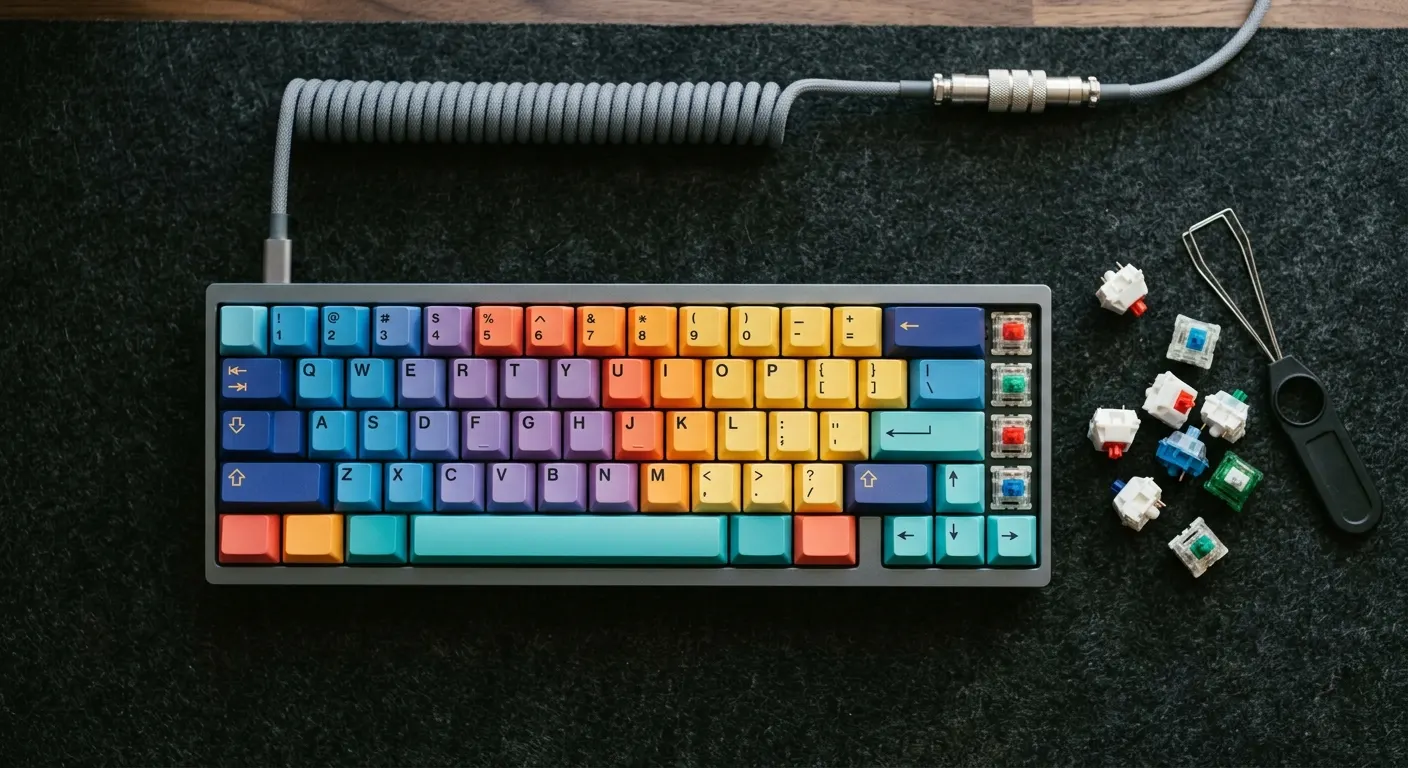
The custom side of the hobby has a wide price range. Enthusiast guides report a typical custom build at roughly 200 to 600 dollars, with keycap sets running from 20 to 30 dollars for budget options up to 100 to 400 dollars for premium sets, and individual switches from about 0.30 dollars for clones to around 1 dollar for Cherry MX, multiplied across the 60 to 108 switches a full board needs.
That switch math is why switch choice is the highest-leverage decision in a build. A smooth, well-regarded linear like the Gateron G Pro 3.0 Yellow Linear Switches delivers most of the premium feel at the budget end of the range.

Gateron G Pro 3.0 Yellow Linear Switches
Factory-lubed linear switches with a smooth, consistent travel and a 35g actuation weight. The most recommended budget linear for first builds.
Sources
SNS Insider, Mechanical Keyboard Market report, 2025, via Yahoo Finance.
Mordor Intelligence, Mechanical Keyboard Market, 2026.
SkyQuest Technology, Straits Research, Market Research Future, and Coherent Market Insights, mechanical keyboard market reports, 2025 and 2026.
Verified Market Research, Computer Keyboard Market, 2025, the broader keyboard category.
Switch and Click and XDA Developers, enthusiast build-cost guides, 2024.
Keep reading
Related comparisons
Related roundups
FAQ
Frequently asked questions
How big is the mechanical keyboard market?+
Research firms put the global mechanical keyboard market just under 2 billion dollars for 2024, with SNS Insider at 1.97 billion and SkyQuest at 1.98 billion. A broader computer keyboard market that includes office and membrane boards runs much larger, around 6.85 billion dollars.
How fast is the mechanical keyboard market growing?+
Estimates range widely. SNS Insider projects a 13.12 percent CAGR to 5.26 billion dollars by 2032 and Coherent Market Insights 15.4 percent, while Mordor Intelligence is more conservative at 5.19 percent. All agree the direction is up, led by gaming and the enthusiast build community.
What share of mechanical keyboards is for gaming?+
Gaming dominates. SNS Insider attributed 63.7 percent of the 2024 mechanical keyboard market to gaming, and Mordor Intelligence put gaming and esports near 60 percent, making it the single largest use case.
Are linear or tactile switches more popular?+
Linear switches lead. SNS Insider gave non-tactile linears about 43 percent of the market and Mordor Intelligence about 45 percent, ahead of tactile and clicky types. Optical and hall-effect switches are the fastest-growing category.
How much does a custom mechanical keyboard cost?+
Enthusiast guides put a typical custom build at roughly 200 to 600 dollars. Keycap sets run from 20 dollars for budget options to 400 dollars for premium sets, and a full board needs 60 to 108 switches priced from about 0.30 to 1 dollar each.
Are wireless mechanical keyboards taking over?+
Not yet, but they are gaining. Wired boards still hold 59 to 69 percent of the market depending on the research firm, but wireless is the faster-growing connectivity segment as low-latency designs mature.